Chapter One
The Bogs
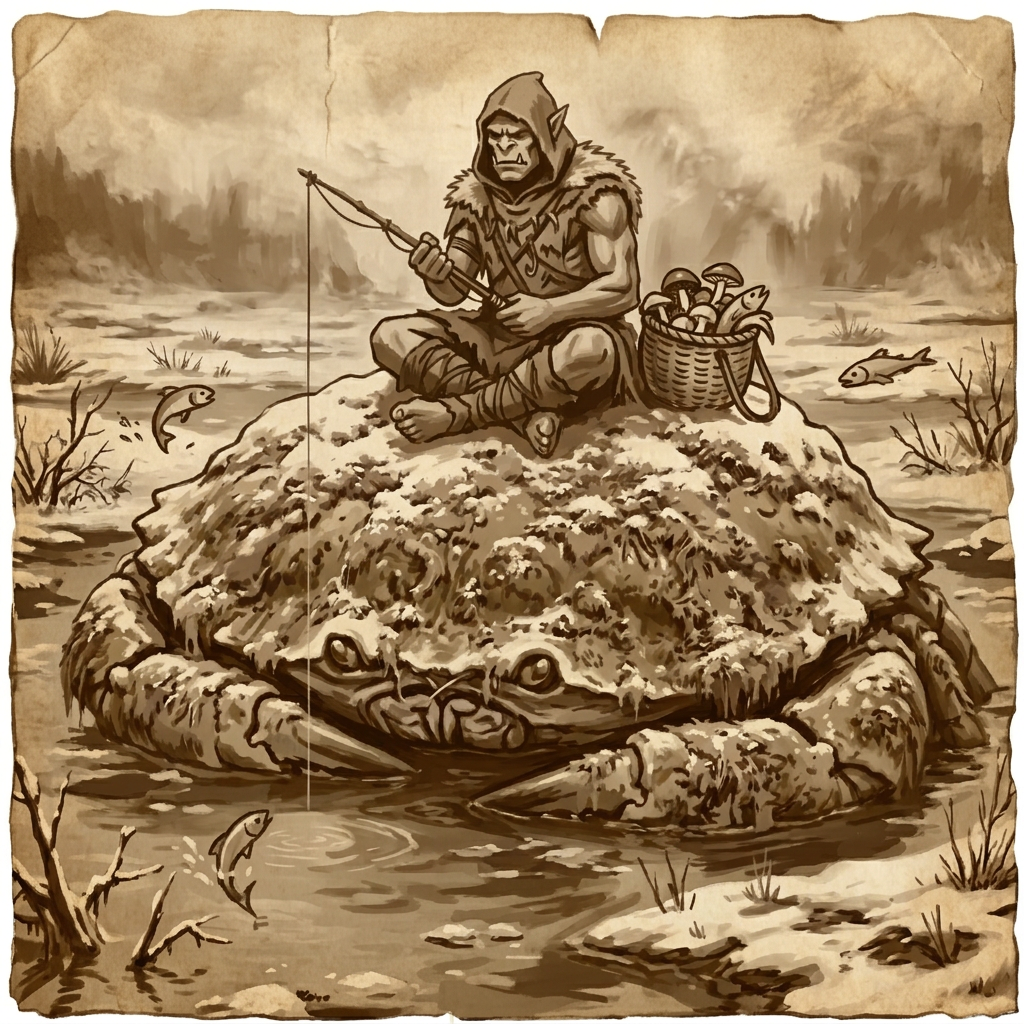
The Watcher at Rest
In the fabled Greyveil, the orruk comes in two reliable varieties: large, and green. The snowy boglands at the heart of the Guttermere, however, have reviewed this arrangement and produced an amendment: the swamp orruk — smaller, sharper, and prone to the dangerous and faintly embarrassing habit of thinking before hitting. For all their differences, they share one certainty: each is the greatest brawler in the land, and the land, being sensible, allows such disputes to sort themselves out.
Which brings us neatly to our specimen: a lone orruk, seated upon a crab, fishing in a cursed bog and completely unaware that he will one day be revered as a saint amongst his people. Observe now the humble swamp orruk in his native country…
Our specimen is called Moggruk, and he is fishing.
He did it the way he did everything: slowly, with the whole of his attention, and in a manner the rest of the klan found difficult to watch for very long. A swamp orruk fished in order to eat. Moggruk fished as though the bog were a tally and each fish a mark scratched into it, and this was the first of several reasons the others had stopped asking him along.
He was seated on a crab.
This wants a word of explanation… because a good deal of bog politics is settled by the question of who is sitting on what. The crab was a Greymoss, grey through the long middle of its life and going purple in its long years, broad across as a coracle, and it had been getting slowly larger since before Moggruk's klan had a name. It grazed the pale mushrooms off the hummocks, it declined, on principle, to drown, and it bore the weight of one small orruk with the serenity of a thing that had retired from every ambition except the single one it was good at. Greymoss crabs did not like being ridden, and attempts generally ended in violence. This particular crab had decided it was not being ridden. It was being sat upon, which was a different arrangement entirely, and one it was prepared to allow.
The line drew tight, and he lifted out a whiskerfish — broad and flat and grey-brown and profoundly sorry to be anywhere at all. He knew this fish. Everyone in the mire knew this fish, because to eat one was to pass the rest of the day beneath a low grey weather of the spirit, convinced that effort was pointless and the bog was cold and nothing could be done about it. He laid it in the basket with the mushrooms he had picked earlier, and observed, without alarm and without remark, that there were a great many whiskerfish in the water today. More than the water usually troubled to keep in one place.
This mattered. It would be some hours yet before it mattered out loud.
To understand why, one must understand the whiskerfish. For the whiskerfish was two animals wearing the one skin. Alone, it was the most dejected thing in the bog — a creature that seemed to apologize merely for existing. But let enough blood or a fresh kill reach the water at once, and the whole sulking shoal transformed in a single stroke into something brass bright, quick, and utterly without manners: one creature with a thousand mouths, which could not tell bait from line from the hand that held the line, and did not try to learn. Moggruk had watched it happen. He had learned that they become very good company and very poor neighbors. The fish were not frenzied yet. They were deciding. Their feelers had begun, one by one, to stand.
This was the thing Moggruk was good at, and the thing that had made him the smallest and least-regarded orruk in a klan that priced worth by how hard you hit and how soon. He was not big. He was not loud. He had never once krumped a thing the others couldn't see needed krumping, because by the time the others saw it, Moggruk had generally been watching it for some while — and watching, in the bog, is the thing the prey does. A boss does not watch. A boss acts, and is followed for it.
And underneath all of it, held down behind his teeth where it did not get out, sat the small cold fact that Moggruk was the cleverest creature for a long way in any direction, and that this frightened him a good deal more than it comforted him. Being the cleverest creature in a country of monsters did not make you safe. It only meant you understood, with uncomfortable precision, how many things could kill you and in what approximate order. The others were spared this. They had never counted it up.
Moggruk counted everything. He had counted, this morning, eleven things in the immediate bog that could end him, and he was sitting on the largest. His klan had a word for what he did, and the word was watcher, and they said it the way you name a smell you have already decided not to go looking for. It was not that cunning went unprized — a swamp orruk prized it highly, but only the kind with a deed on the end of it: the quick trick, the clever kill, the trap that paid. Watching, on its own, with no deed coming after, was not that prized thing. It was just watching.
The crab shifted — not for him; for the mushrooms — and Moggruk heard the sound of something large declining to be quiet — three honest splashes and a fourth that gave up partway — all of which belonged, in the end, to Brakka, wading out through the reeds with the dogged thoroughness of an orruk sent to fetch and meaning to fetch.
"Boss wants yer fish," Brakka said. He looked into the basket. "An' yer mushrooms." He looked at the crab, which looked at nothing, having seen everything once already and found it sufficient. "Dere's a trap on."
Moggruk looked up at him. Brakka was the one orruk in the klan who said boss wants yer fish in place of oi, watcher — and that small economy was the entire substance of their friendship, and it was plenty.
"Wot's da trap," Moggruk said. It was not really a question. It was a line let out to see what rose to it.
"Big un," said Brakka — which told Moggruk everything and nothing, in about the proportions Brakka generally managed.
So Moggruk drew in his line and gathered his basket. The crab, registering a reduction in its duties, did not respond, having freed itself long ago from the tyranny of responding to things. And the small orruk waded off after the large one, toward the boss and the trap and the great many whiskerfish — carrying his fish, and his mushrooms, and the one fact nobody had thought to ask him for.
The klan had made its camp on the only hummock for a mile the mire had not yet got around to swallowing, on a shelf of firmer mud above the black slack channel — and Wutzgut da Gnasher stood at the lip of it with his back to the water, which told you something about Wutzgut, who had never once in his life considered that the interesting thing might be behind him.
He was the biggest swamp orruk Moggruk had ever stood near, and — this was the part the others never troubled to notice — he was not stupid. Wutzgut had kept the klan fed through three hard winters by being reliably right about how to take large things in a wet country, and he wore that record the way he wore everything, as a fact of weather. As Moggruk and Brakka came up out of the reeds he was working his jaw slow, side to side, the great tusks grinding one against the other with the unhurried sound of two millstones with all the time in the world. To anyone who had lasted a season near Wutzgut, this was the sound of a decision arriving. It was not, as a rule, the sound of the right one.
"Da watcher," Wutzgut said, around the grinding, and did not turn. "Brung 'is little fishies."
Vragg da Bruzah was at the boss's shoulder, which was where Vragg did his best leaning, and he picked the cue up off the ground where Wutzgut had left it, the way he picked up every cue Wutzgut left lying about. "An' 'is mushrooms," Vragg said, loud, for Wutzgut, and watched the side of the boss's face to see it land — which was the thing Vragg did in place of being liked. "Whole bog full o' proper work, an' our Moggruk's been out pickin' flowers."
"Set 'em down," said Wutzgut. Moggruk set the basket down where the boss could have seen it, had the boss been the sort to look.
The plan, when he laid it out, was a good plan. This is worth saying plainly, because nothing that followed was the plan's fault. "Dere's a grey in da slack water, off da drowned willows. Big un. Bigger'n a krumpin' kradle, near enough." He let the number sit, because a number that size earned a sit. "We drop da deadfall on it where da mud runs soft, rope it down 'fore it gets its claws sorted, an' open it up where it lies."
Brakka, who had been listening with his hands — they were already plaiting a fresh length of line of their own accord, the way another orruk's foot might tap — said only, "Deadfall'll want two props an' a back-stay in dat mud. I'll set it." That was Brakka agreeing.
"Gnik, Snag, an' you two" — Wutzgut did not know the names of the two youngest and had never seen the percentage in learning them — "on da lines. Loop on each big arm da second she's down, an' you lean back, an' you do not let go." Gnik, who was tall enough that the whole performance of being told things happened somewhere down around his chest, grunted that he had roped crabs before. He had. It had always worked before, which is the most dangerous sentence in any language.
"Mulch, in close wiv me an' Vragg. Soon as she's roped we go in unner da front an' do da soft bits, quick, 'fore she works out she's caught." Mulch cracked his knuckles, which was Mulch's entire contribution to most conversations and the most honest thing he ever said.
Gobber — who carried the morale of the klan the way Brakka carried the rope, as a thing she could not put down — had already decided the crab was called Supper, and said so, and two of the boyz laughed, which was the whole point of Gobber. "An' Moggruk lays da bait," she added, with none of Vragg's edge on it. "Fish an' mushrooms in a line to da willows. Supper can't say no to mushrooms."
"Lay da bait," Wutzgut confirmed, "an' den stay back. It's da one fing yer good for." There was no malice in it. That was the worst of it — there was no malice in it at all. It was the boss's flat, honest assessment of a tool, spoken to the tool.
Moggruk looked off toward the drowned willows, where the slack water sat fat and dark and far too still, and where — he could see it now, a grey mound the eye wanted to call a rock and the gut would not — the big grey lay in the channel like a dropped shield. It was a hard, flat, killing grey, grey to the joints, with not a thread of purple come into it yet. A crab that size ought to have gone soft and mossy and given up the predator's trade years since. This one hadn't. This one had stayed in its mean years and gotten large in them, which meant it would fight like the little ones that drowned waders in the channels, with the arms of a thing twice their size. The boss saw a big crab. Moggruk saw a big crab that was the wrong colour, in the wrong water, on the wrong day.
And the dead water was where the dying happened, and a thing that ate the dying went where the dying was. So did the whiskerfish. Every danger in the bog had quietly agreed to gather in the single stretch of it his boss had just chosen, and the boss had chosen it with his back to it.
He let out one line, because it cost nothing to. "Lotta fish in dat cut."
"Den you'll have summink to watch," said Vragg, and that was the end of it.
So Moggruk took up his basket and went to lay a careful, well-spaced, genuinely excellent line of bait, drawing the most dangerous thing in the bog toward the second most dangerous thing in the bog, at the instruction of orruks who had counted neither. He laid it well. He always did the small things well; it was the only craft they let him keep, and a craft is a craft.
Behind him the feelers went on standing, one by one, in water nobody was watching but him.
For a while it went exactly the way Wutzgut said it would, which is the cruel part. A plan that fails at the first step teaches you to build a better one. A plan that works right up until it doesn't teaches you nothing.
The klan took their places the way they always did. Brakka crouched at the deadfall's near prop with one hand flat on the back-stay, feeling the rig the way he felt everything. The ropers fanned along the firm lip, lines coiled and running down into the cut — Gnik tallest among them, Snag beside him, and the two youngest, Drub and Nazz, taking the off-side arm between them. Drub waded a half-step forward of the line, shin-deep at the channel's edge, because forward was where a young orruk without a name yet went to get one, and Drub was keen the way you are keen before you have learned what the big things cost. Moggruk knew both their names. The boss had never seen the percentage in learning them. That, in the end, was most of what was wrong, and nobody but Moggruk had counted it.
The grey came to the bait. It came the way its kind came to everything, as though it had thought of coming first and the bait had merely agreed: one slow shield-width at a time, up the line of fish and mushrooms, until the whole grey bulk of it stood square on the soft mud beneath the fall — lower than a thing that size had any business being, the way the channel-crabs go low before they take a wader.
Brakka pulled the prop.
The deadfall came down the way good craft does, square and final, and it did what Brakka built it to do — and a little more, because the edge of it caught the foremost leg at the joint and took it off clean. That was the first thing that went not-to-plan, and it went wrong by being too good. The crab screamed — crabs do, a sound like a wet hinge, felt more than heard — and the leg went into the channel, and the wet of it with it. For one whole heartbeat the plan was working: the grey down, slewed and pinned, four lines singing tight, the soft front bared. Moggruk saw the heartbeat for what it was, which was the last one.
Then the water, which had been deciding all morning, decided. The slack black cut went pale, then bright, then all at once into one animal with a thousand mouths and no opinion as to which of the things in it was crab and which was rope and which was the leg of a young orruk standing a half-step too far forward. The whiskerfish, briefly, were having the best day of their lives.
Drub had the off-claw, and he was braced against it, leaning his whole keen young weight back on the line the way you do when the thing on the other end has just learned it is caught. Then the water found his legs. The fish came up under him all at once, and his footing went, and the lean he'd been holding turned into a stagger — and that was all the slack the grey needed. A Greymoss in its mean years does not waste an inch. It hauled the roped arm in hard, dragging Drub half out of the water by the rope still wound on his fists — and then it brought the claw across and took the arm off at the shoulder, rope and all, as neat as the deadfall had taken its own leg.
Snag went into the water.
Snag, who had asked is that safe and been answered with a joke — Snag went down off the lip into the brass-bright cut after Drub, because the one who smells smoke at every fire is also the one who has worked out, in the long hours of being ignored, exactly where the door is. He got a fist in Drub's harness and hauled, and the water collected its fee off the both of them, up the arm, to the elbow, and Snag held on through all of it and dragged the young one back onto the mud. Most of him. Not the arm; the arm was the bog's now, and the rope with it.
And the claw, with nothing roped to it now and nothing in its way, came round and found Nazz, who had been standing where Drub left him. It closed on him round the middle, and then it squeezed, and the one orruk became two. Moggruk did not watch that part. He had already counted it; counting it had been enough.
What ended the rest was not cleverness. It was Wutzgut. The boss came over the willow-roots with Vragg at one shoulder and Mulch at the other and went in the old way, the only way he trusted — straight at the front of it with everything he was. Mulch hammered the eye-stalks down and took a claw along the ribs and kept swinging. Vragg fouled the working arm with a gaff. And Wutzgut da Gnasher drove a spike of bog-iron up beneath the front shell into the soft seam behind it — the exact seam Moggruk's bait had taught the crab to lift its head and bare — once, and again, and a third time, until the great grey arms came down and stayed down. It was, even drowning in its own bad luck, magnificently done. It was also a thing they were only doing because nobody had counted the fish.
The crab died in the boiling water, and the boiling water set about collecting at once. They got lines on the carcass and they hauled, all of them, even Gnik with his hands chewed to the bone, and the bog hauled back through a million small mouths, and what came up onto the firm mud was something less than half a crab. The rest stayed in the cut, and the cut was glad of it.
So they had their meat. They had enough. They had it at the cost of Nazz dead in the reeds and Drub gone grey-under-green and one-armed and likely to follow him before morning; every roper bitten to the elbow; Snag sitting at the channel's edge with his arms held away from himself like things he no longer wanted, looking at the water with the face of an orruk whose question has been answered in full. And Brakka, with nothing left to rig, already and helplessly beginning to coil the back-stay back up, because his hands did not know what else to do with themselves.
Nobody looked at Moggruk. There was no reason to. The boss had made the kill, and everyone had seen the boss make the kill. That the kill had been made necessary by the one thing the watcher watched was not a thought the klan had the shape to think, and Moggruk knew better than to try to hand it to them. He had said there were a lot of fish in that cut. He had said it the once, because it cost nothing to. It had cost nothing. It had changed nothing. That, he was beginning to understand, was the whole of what watching was worth, in a klan that priced a thing by how hard it hit.
Wutzgut set a foot on the half a crab and looked at it a long moment, breathing hard, and the thing that crossed his face was not triumph. He had kept the klan fed three winters by knowing the difference between a kill and a good kill, and he knew the difference now. His tusks had started already, slow, side to side — two millstones beginning in on the next decision before the water had finished eating the last one.
"Get it on da fire," he said. "We'll talk after."
The fire was a poor, grudging, spitting thing — everything in the bog that would burn had to be argued into it first — but it was enough to blacken the outside of a crab, and there is a thing the swamp orruk does with a blackened crab after a disaster, and it is the same thing it does after a triumph, there being in the orruk mind no very firm line drawn between the two. It eats the cause. So they ate the crab.
Half a crab, it turned out, was still a great deal of crab; there is that to be said for paying too much for a thing, that you do at least come away holding it. They ate the way the wounded eat, seriously and without much talk, because the day had used up most of the talk they had, and each of them grieved, or didn't, in the grammar of their hands.
Snag had laid Drub out beside the fire and was sewing him. He worked a bone needle and a length of gut through the puckered ruin where the arm had been, small even stitches, his tongue between his teeth, pausing now and then to wipe his hands and begin again. Drub had gone the colour of old moss, the green draining down toward grey, and he did not flinch at the needle, which was the worst sign of all, and Snag sewed faster because of it. He had gone into the water for the lad. He was not going to be the one who stopped.
Gobber went down the line of bitten ropers with a strip of boiled rag and a commentary, because a wound dressed in silence was a wound an orruk had time to think about. "Look at da state o' yer," she told Gnik, winding the ruined hands. "Chewed to da bone, holdin' a rope nobody else 'ad da grip for. Dat's not nuffin'. Dat woz da only line dat 'eld." Gnik said something low about it being his job. "It woz," Gobber agreed, "an' you done it" — and tied it off and moved on, leaving Gnik fractionally taller than she had found him, which was the whole trick of Gobber, and the reason the klan would have followed her anywhere had she ever once wanted them to.
Vragg sat apart with the slim end of one of the great walking legs, drawing the meat out in long threads with his back teeth and his eyes half shut, attending to Vragg. He had fouled the claw with a gaff, and he would tell it, later and often, as the moment the kill was made. And Brakka had a lapful of shell-shards and was turning them, fitting edge to edge and taking them apart and fitting them again, building nothing yet in the way his hands built nothing yet right up until the moment they had been building the thing all along.
Wutzgut ate like a landslide, and talked through it, the talk coming round the eating in pieces between the crack of shell going under his tusks and the long wet pull of meat out of it.
"Dis marsh is done," he said, and bit clean through a knuckle of claw, and sucked it hollow. "Time woz, you put a trap in dat cut, you pulled out a crab an' went 'ome. Now you put a trap in dat cut an' it costs yer two boyz an' an arm an' you get 'alf a crab, 'cause da uvver 'alf's gone down every fish in da Guttermere." He said it the way an orruk says a thing he has decided is true, which is a different sound from an orruk saying a thing that is. "Da bog's et out. Trapped flat. Bin tellin' ya."
He had not been telling them. But nobody in a klan corrects the boss's memory of how right he has been, and so it became, in the telling, a thing he had always said.
"Out west, now." And here the grinding stopped, and the eating stopped, because this was the part the millstones had been working toward all along. "Out west it's ruins. Old stone, fell-down places, an' da gettin's fat 'cause nobody's worked it in an age. Soft fings. Slow fings. Little dumb fings wot don't even know dey're caught till dey're et." He spread his arms, the claw still in one fist, and the firelight made him briefly enormous. "We go west, we sit in da stone, an' da fings come to us, an' we trap 'em easy, an' we live like da big green bosses live, on land wot don't try ter drown ya. Dat's da life. Dat's out west."
It was, as a pitch, very good. Wutzgut gave a good speech the way he ran a good plan: total conviction, and no margin set aside for the thing he had not counted. And it landed, because a klan that has just buried a day wants very badly to be told the next one is somewhere else. Vragg was nodding before the boss had finished, loudly, where the boss could see; but the others came to it slower and meant it more.
It was Brakka who said it, not looking up from his shell. "Pale fings is west."
"We keep off da pale fings," said Wutzgut, easy, having already had the thought and dismissed it and seeing no cause to host it twice. "Stick to da stone an' da scavengin'. Dey keep to deir water, we keep to ours. Ain't nuffin' out dere wants da bog-ruins but us." And he drew the line as he drew most lines, clean down the middle of a country — their water, our stone, the bog between — and he drew it, as he drew most things, with his back to the part that mattered.
This would have been fine, had Wutzgut been even approximately correct about the pale things. He was not. Wutzgut's pale things presented a difficulty, though not the one the orruk had prepared for. Orruks prepare, as ever, for being hit. The orruk's word for them was enemy, and the word did the orruk's thinking, which was the arrangement the orruk preferred in all his words. The facts the word omitted were these. The west was not empty; it was merely reduced — down from a very great many to a few, and the few still enough to unmake a klan between courses. The things there were not dumb. And they were, by inclination, kind: a wandering orruk stood an even chance of being swatted out of the air like a bog-fly or of being brought a blanket and a hot bowl and made comfortable — the two being, from the pale thing's side, exactly the same gesture, performed with exactly the same goodwill, and being, from the orruk's side, equally fatal, on the grounds that a creature braced its whole life for murder has no notion at all of what to do about hospitality.
Little fings wot don't know dey're caught.
It was the truest thing Wutzgut would ever say, but for all the wrong reasons.
By the fire none of this was known, and so it changed nothing, and the klan talked itself west the way a klan settles a thing around a fire — fed, bandaged, and wanting very badly to believe in soft dumb things that walked into pots. They would break camp in the morning.
Moggruk sat at the edge of the light, eating his share, which was the small one, and counted the speech the way he counted everything. He did not doubt the marsh was thinning; he had watched it thin, the water going wrong year over year in a way he had no word for — heavier, sadder, quicker to turn. The boss was right about the leaving. The boss was right the way a stopped trap is right twice a day. And west he knew nothing about at all, except that little dumb fings wot don't know dey're caught was a phrase he turned over and did not like the shape of, and could not have said why, and that a boss who draws a clean line down a country has generally not asked the country whether it holds to it.
He said none of it. He had said his one thing that day, on the fish; it had cost nothing and changed a dead lad and a maimed one and nothing besides, and he was learning, in the slow careful way he came to everything, that there is no good in being the only one awake when the only one awake is also no one. So he folded it down small behind his teeth with the rest, and let the boss sell them the west, because the boss was going to sell them the west whether Moggruk spoke or not, and all that speaking would buy was how it felt to be Moggruk afterward. It was the first properly useful thing he had ever done with the cleverness that frightened him: nothing at all. He would, in time, get very good at it.
Beside him, Brakka's hands went still. He had made something after all — a small hooked scoop of shell, ground sharp against a stone, the kind of thing for working the meat out of the little bones — and he turned it over once and set it down by Moggruk's foot, not looking at him, not saying anything, the way you leave a thing where a body will find it and not have to thank you for it. Then his hands found another shard, and began again.
The sun went down over the Snowy Bogs, and did it the way it did most things there, which was without ceremony and behind cloud — no fire on the water, no long gold across the reeds, only the grey going by degrees too small to catch to a darker grey, and then to no grey at all, until the smoke and the reeds and the half a crab and the orruk being sewn back together by firelight had all gone the same flat charcoal as everything else, and it was night, the way it is night when a day cannot be troubled to end on a better note. In the morning they would go west.
Moggruk sat a while longer than the rest, looking the way they would all walk, and counted what he could of a country he could not yet see, and knew that it was not enough — which was the single advantage he had ever held over anyone, and had never once been thanked for either.